
Reflection
On Teaching and Guiding
Guiding · One Life in Love · Teaching
Teaching has its place when knowledge can be examined and shared. But what about the art of living? Can anyone really teach us how to live, or do we need something different?
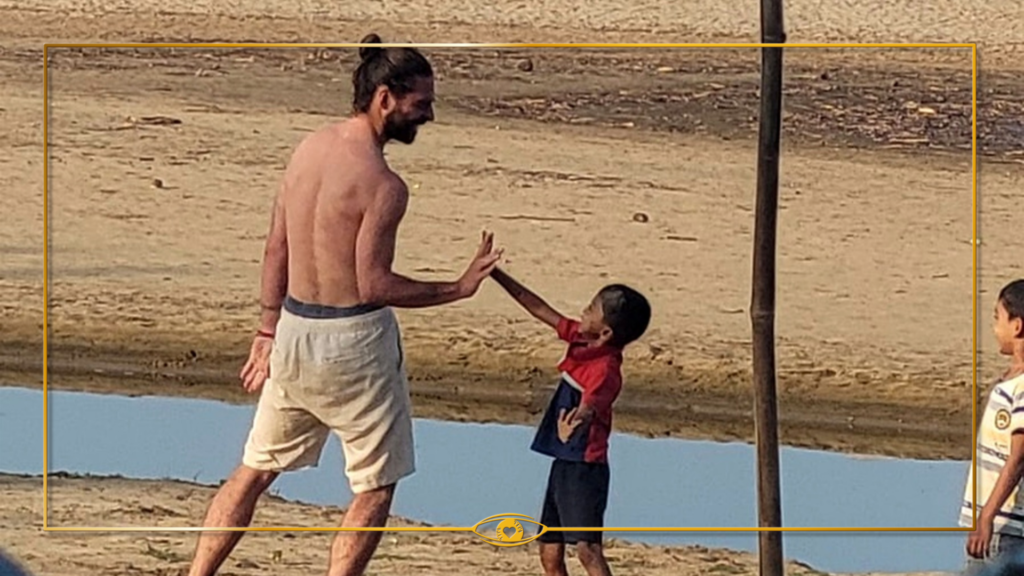
Living from Truth, Freedom, and Love
I wonder if teacher is actually the right role for many of those who help us navigate life. A teacher, in the classical sense, passes on knowledge, facts, and methods. Therefore, explains, instructs, and helps us understand something we do not yet know. This makes sense in fields where knowledge can be examined, tested, and shared with some degree of collective agreement.
To me it makes a lot of sense in natural sciences, law, or history, and it makes some sense in Yoga, for example, when we learn how to perform an asana or a kriya. Of course, our understanding in all fields is never complete, and what we consider established knowledge today may change tomorrow. Yet there is enough common ground for classical teaching to have its place.
Do we really need teachers in the art of living?
I doubt it. In fact, I wonder whether our hope of finding someone who can teach us how to live may do more harm than good. What can anyone confidently teach another human being about the art of living? Of course, we can teach practical skills. It is good to have someone, in best cases our parents to teach us how to tie our shoelaces, how to prepare food, or how to take care of our bodies. But beyond that, how can anyone confidently teach another human being how to live in accordance with their own truth? Many of us know, that our parents definitely can’t.
I believe that this is where teaching reaches its limits and guiding begins. Because when it comes to the art of living, we are no longer dealing only with knowledge that can be passed from one person to another. We are dealing with experiences, interpretations, emotions, contradictions, and questions that may have very different answers depending on the person, and his or her unique stories, asking them.
We can gain insights from others. We can receive perspectives, discover new ways of thinking, and develop skills that help us navigate life. But this is mostly not teaching in the classical sense. Instead, we should call it guiding, because the purpose is not to hand someone the correct answer, but to help them discover their own.
Guiding someone along the way to navigate the ups and downs of life. Not judging a person’s circumstances and reactions to them, but helping them to find their own judgment of those circumstances.
Guiding leaves room for co-creation, co-learning, and growing together. While teaching often begins with knowledge that one person intends to pass on to another, guiding begins with the understanding that neither person may know where the journey will lead. It leaves room for failure, for changing directions, and for discovering something together.
When one human influences, leads, or supports another human, what qualities of such a person should we actually trust?
Often, the image of a good teacher is still tied to someone who is serious, someone who believes they are right. In passing on facts, those qualities certainly have their place. They allow us to get to the point of it faster.
Isn’t it also true that many of us were conditioned to believe we must become serious, strong, and right in order to seem successful in life?
And I wonder how much good this thinking has brought to us and to the world. We have created systems that still reward seriousness, hardness, and certainty. Yet when we look closely, we may begin to see that these are often the very qualities that disconnect us from the nature of life itself.
So instead, what qualities could we look for when it comes to the art of living? What is actually needed when working in self-development, healing, therapy, spirituality, and all the fields concerned with how to bring more sense into our lives? Basically, wherever one human helps another human. Or imagine a mother helping her child to find its place in the world.
Maybe it is not the one who appears serious, strong, and right. Maybe it is someone playful, someone able to be honest about weakness, someone who knows that being right is often more subjective than we think and can change with context, perspective, and circumstance.
These qualities receive far less collective recognition. Yet maybe they are exactly the qualities we should learn to value more.
It is time to measure those we seek guidance from differently. Here is why:
Life is not supposed to be serious.
If it were, we would be born serious. Instead, we learned to be serious. We learned to worship correctness, and we learned to dismiss failure. Yet we learn more from failure. We learn more from being wrong.
Let’s not confuse seriousness with awareness. Awareness is the ability to be present and alert when the situation demands it. To get things done, to survive, to help. Instead, so many of us have become stubbornly serious, even when it is about giving the right description of the current weather or holding a figure of your body in precise equilibrium.
Crazy enough, I recently saw a video of a man riding his bicycle onto the last stretch of the Tour de France without being one of the contestants. A security officer tackled him at full speed, putting both of them at serious risk.
For what?
Well, to keep it all very serious.
What a joke it is that seriousness became more important than the health and safety of a human being. I ask, why not let the man ride his bicycle for a few meters on the road of the Tour de France, if it makes him happy? You wouldn’t have to applaud him. I, on the other hand, probably would. Just my type of humor. And I would think, wow, what a courageous man.
Also, you may want to consider not taking grown men who ride bicycles to find out who is the fastest too seriously.
Maybe this is what happens when rules are protected more seriously than life itself.
To be a guide for another human in life, one has to be playful. One needs to understand that life is to be enjoyed and that seriousness has its place only when circumstances demand it. But we have somehow made seriousness our usual way of being, even in moments that ask for nothing more than openness and a little laughter.
Life is not supposed to make us hard.
The idea of strength is a very complex one. I often witness that people confuse strength with the inability to show weakness. Often, it is not strength. It is the illusion of strength.
When a person does not show feelings, when a person does not allow an argument, when a person does not accept help, and of course when a person does not give something of themselves for others, many consider that to be a strong person.
To me, this does not look strong. It looks deeply weak.
Yet many political leaders act exactly like that. Many managers and team-leads seem as if they need to be exactly like that. Many teachers of life appear exactly like that.
Why?
Because most of us still worship them.
These ideas of strength, however, can become obstacles when guiding another human being. Because how can we invite someone to be honest about their fears, weaknesses, and uncertainties if we are constantly pretending to have overcome our own? A guide who cannot accept their own humanity may find it difficult to fully accept the humanity of another.
To be a guide for another human in life, one has to be able to be honest. Honest with themselves and honest with the world. Honesty asks us to be sad when we are sad. Happy when we are happy. Angry when we are angry. Yet it also demands the awareness not to let those emotions rule our actions toward another being.
Life is not supposed to let us always be right.
Life shows us over and over again that we are wrong. Yet we find ourselves over and over again in situations where we defend our opinions, our knowledge, our stubborn perspectives.
It is sad when we are no longer able to be wrong. Because actually, we put a lot of unnecessary pressure onto ourselves. If we think we must be right at all times, then life again becomes very serious.
Sadly, teachers are especially vulnerable to the disease of having to be right. It is a disease because the moment you stop being wrong, you stop growing. That’s it. You found your knowledge, and from here it only goes downwards.
To be a guide for another human in life, one has to be able to keep learning. In order to keep learning, we must allow ourselves to stay open to the possibility that we are wrong.
A good guide is one who never stops learning through clients, friends, family, through every encounter and every experience in life. If one is not capable of that, one should not guide, teach, or lead, because one has forgotten the basic understanding of growth.
So how could one help someone else grow? By remaining a participant in life, rather than becoming someone who believes they have risen above it.
Playfulness as a way to see life. Honesty in our weakness and strength. Being wrong as a way to grow together.
I wonder how much good this shift in perspective could bring to the world. And I wonder how much good it could bring to our own path of learning and growing. To the way we choose who we learn from. Who we allow to guide us. And for what reasons. Whether someone is here to teach or to guide, maybe we should ask more carefully what qualities we want them to carry.
Maybe we do not need more people who teach from above. Maybe we need more people who are willing to guide from beside.
Leaders, teachers, guides, and humans who are playful enough to stay alive, honest enough to stay human, and humble enough to keep learning.
I would like to see a world that measures them differently.